I’m gonna let you in on a little secret. (Well, it’s not that much of a secret.) Interior designers and decorators spend exponentially more time researching, planning, shopping and buying than they ever do actually decorating. After all, you can’t decorate very well with what you don’t have. In fact, design professionals are as much professional shoppers as anything else.
Since budgeting and spending money are such important, critical parts of our jobs, I thought I’d get a little personal about how I like to shop for clients and how much I appreciate people who hire and trust me to spend their money.
In a couple different, recent Google reviews our clients wrote:
- “Jeff was very mindful of the budget throughout and helped prioritize where it made sense to spend versus save.“
- “He (Jeff) kept a careful eye on costs and was always looking for the most economical options.“
“Spend vs save” and keeping an “eye on costs” are common themes in our client feedback. From experience, they’ve learned it’s more than a sales pitch. I truly try to spend their money on the things we need just as if I were spending my own hard-earned cash. And here’s another little secret. “It’s not what you spend, but how you use what you buy!” that matters most!
Thanks, in large part, to the internet and online retail, savvy shoppers (like me) have learned not all retailers are alike, even though they may sell the exact same or very similar items. And if you’re shopping online, quickly adding items to your cart the minute you find them and clicking “Buy Now”, you’re probably spending money you might not have to spend.
Let’s talk about the illusion of retail pricing for a second. How is it you can walk into one store and see a lamp priced at $79. Then stroll into another store, a little while later, to find what is essentially its long-lost twin for $279… We’re talking same shape, same materials, same glow. Why the extra $200?
This exact thing happened once when I was shopping with a client for her project. We were trying to find as many good deals as possible to style a new-build condo in Naples, FL. And we needed EVERTHING! Of course we’d planned and ordered all the big stuff (furniture) in advance and it had all been delivered. But for the details, we decided to wait until we were onsite to shop locally for the smaller things (lighting, rugs, art, greenery, pillows and accessories etc…).

Anyway, while we were shopping at one of the local discount retailers for goodies, we discovered a tall, matte-finished white porcelain vase with blue dot stripes (might look familiar to some of you). I knew immediately that it looked and probably was much more expensive elsewhere and it would really help elevate our look. After some convincing, my client agreed it was definitely worth the $39.95 price tag.
No sooner had we finished the project and I was at the airport flying back to Chicago, I received a text from my client. (She just couldn’t wait for me to land to tell me.) While doing some additional shopping, on her own, she’d stumbled across the exact same vase we’d bought at the discount store. But these were proudly displayed in a boutique on 5th Avenue South in downtown Naples. The price tag there read $429!!! Color her convinced! Of course, I count that as a perfect example of “save vs spend”!
Another good example is a large, oval mirror I found at one of the well-known, brand name stores. Well made with a gorgeous, textured distressed gold finish, plywood backing, and french cleats for hanging, it was a must have, especially since it was on clearance! I bought it 😉
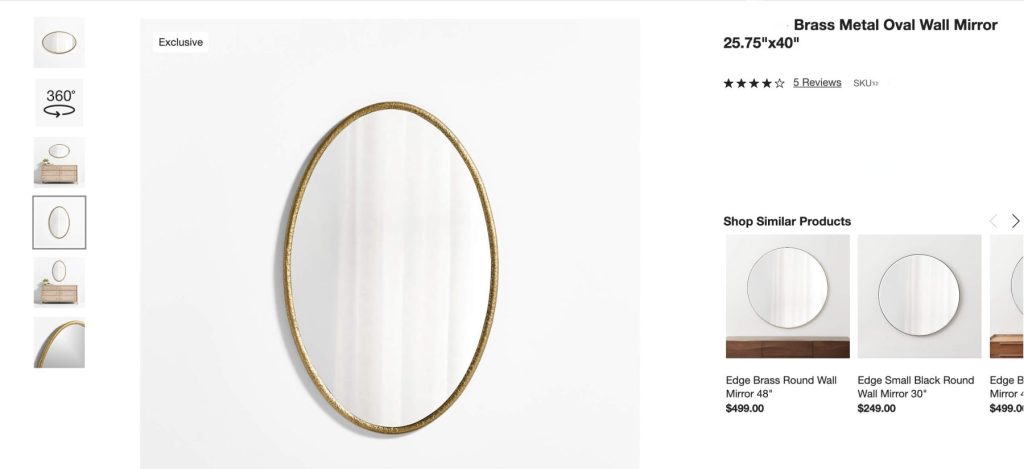
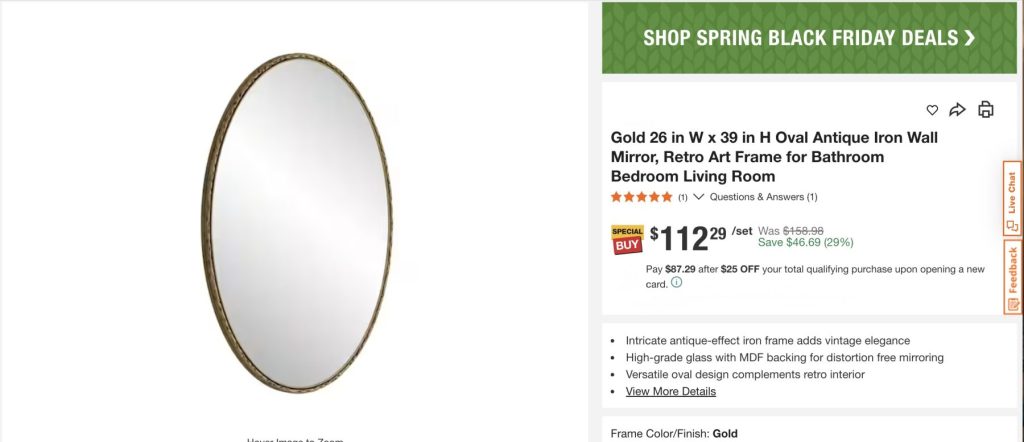
But, to scratch some twisted shopping itch, I decided to see if I could find anything similar online. While the brand name mirror I’d bought had truly been discontinued, I was quickly able to find the same style, size and shape of mirror from a few online sources. The most notable differences, though minor, were in the quality. The online versions, however, offered the same overall esthetic. And without seeing them side by side, you’d probably never even notice they weren’t the same.
The one difference that really stood out, however, was the price! The brand name store’s mirror retailed for $499 (which I scored for less than half, final sale). I found the knock off mirror several places online with the lowest prices being $112. That’s a lot of savings if you can look past the obvious quality differences. Thank goodness I didn’t pay full price or I might’ve regretted my buy!
To be clear, product markup isn’t necessarily about stores being dishonest; it’s about branding, overhead, and sometimes just a really convincing vignette that allows an item to demand a premium price. By the same token, good design doesn’t come from blindly choosing the most expensive option. It comes from knowing what actually matters. And what matters is how things work together.
A well-designed room is like a good dinner party. Nobody cares if the place settings are spectacular and cost a fortune if the seating is uncomfortable and the lighting makes everyone look like they’re being interrogated. But get the flow right with cheaper plates and stemware, layer in some texture, add lighting that flatters instead of frightens, and suddenly even the “budget” pieces feel elevated.
And can we finally retire the idea that price equals quality, across the board? Yes, more often than not, you get what you pay for. But, sometimes it’s more (think good deal… and sometimes even less ( think bad quality). Sometimes you’re paying for a name, a showroom, or a really good marketing team. The key is knowing where to invest and where to save. Upholstery that gets daily use?… Worth spending a bit more! Decorative accessories that just need to look good from five feet away? You have options.
At the end of the day, no one (with an ounce of couth) is gonna walk into your home and ask what you paid for your lamps. They will, instead, react to how the space feels: Cohesive. Comfortable. Thoughtful. That’s what sticks! Because truly, and I will keep saying it until it sinks in… It’s not what you spent, but how you use what you buy.”
So if you take one thing from this slightly snarky pep talk, let it be this: stop chasing price tags! But DO look for deals and research alternative places to buy things. Searching with Google Lens is a great way to comparison shop before you hit the stores.
And on a personal note, please DO HIT THE STORES as frequently as you can! Online shopping is obviously fast and convenient. But, much like clothes and other very personal items, it’s still nice to touch, see and feel home furnishings before you buy them. Put simply, I believe, “If we don’t shop local, eventually, we’re not going to have local to shop!” That will be a shame since many people settle for “less than” versus the headache of returns. And, of course, that doesn’t count the many lost entry level and managerial local jobs nor lost tax revenue for your home town. I know you feel me!
So, shop smart and shop local!
Happy Decorating from Decor Designs. 815-245-2433